
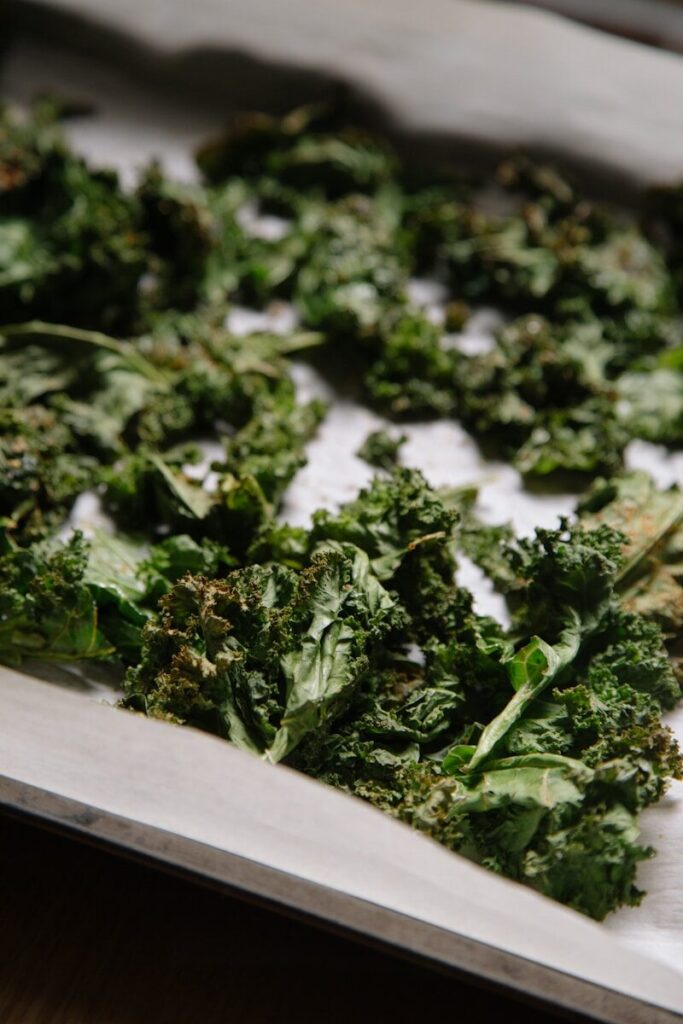
Learn how to make crispy baked kale chips that stay wonderfully crunchy and never taste bitter, perfect for a quick, healthy weeknight snack.
Between running my teenager to track practice and managing our weekly grocery budget, finding a snack we both actually enjoy can feel like a chore. Last Tuesday, I experimented with a single bunch of curly kale sitting in my crisper drawer, determined to master crispy baked kale chips without turning them into a charred, bitter mess. After a few burnt batches over the years, I finally figured out the exact technique that delivers a satisfying crunch every single time.
My kitchen adventures have taught me that greens can be incredibly finicky when exposed to dry heat. According to nutrient databases maintained by the USDA, kale is an excellent source of vitamins A, C, and K, making it a wonderful alternative to processed snacks. However, retaining those benefits while achieving a chip-like texture requires a delicate balance of temperature and prep work.
The Secret to Crispy Baked Kale Chips Every Time
The absolute most important rule of making this snack is ensuring the leaves are bone dry. Even a tiny amount of lingering water from washing will steam the kale in the oven, resulting in a limp, soggy texture. I now wash my kale hours in advance and sandwich the leaves between two clean kitchen towels to absorb every drop of moisture.
Another crucial lesson is to go incredibly light on the oil. I used to pour olive oil generously, which only weighed the delicate leaves down. Now, I use just a teaspoon of a trusted brand of extra virgin olive oil and massage it thoroughly into every single crevice of the kale leaves with my hands.
Ingredients
- 1 large bunch of fresh curly kale
- 1 teaspoon of quality extra virgin olive oil
- 1/4 teaspoon of fine sea salt
- 1/4 teaspoon of garlic powder (optional)
- 1 tablespoon of nutritional yeast for a cheesy flavor (optional)
Step-by-Step Preparation Instructions
First, preheat your oven to 300 degrees Fahrenheit. I have found that cooking at higher temperatures, like 350 degrees, burns the thin edges of the leaves before the centers have a chance to dehydrate and crisp up.
Next, remove the tough inner ribs and stems from the kale leaves. Tear the remaining leafy green parts into bite-sized pieces, keeping in mind that they will shrink to about half their size while baking.
Spread the prepared kale leaves across two large baking sheets in a single, sparse layer. If the leaves overlap or crowd the pan, they will trap steam and lose their potential for that satisfying, airy crunch.
Bake for 10 minutes, then rotate the pans and gently stir the leaves. Bake for another 8 to 10 minutes, watching them very closely during the final moments as they can transition from perfect to burnt in a matter of seconds.
Smart Substitutions and Flavor Variations
While sea salt is a classic choice, you can easily customize the flavor profile to keep your family from getting bored. A sprinkle of smoked paprika adds a wonderful warmth, while a pinch of cayenne pepper provides a spicy kick that pairs beautifully with the natural earthiness of the greens.
If you miss the taste of traditional cheese snacks, nutritional yeast is your best friend. It clings beautifully to the lightly oiled leaves and provides a savory, dairy-free cheesy flavor that my daughter absolutely loves.
How to Store Leftovers to Maintain Crunch
If you happen to have leftovers, store them in an airtight container at room temperature. Do not put them in the refrigerator, as the cold humidity will instantly ruin their delicate texture.
If your chips do lose their crunch after a day or two, simply pop them back into a warm oven at 300 degrees Fahrenheit for two to three minutes. They will quickly crisp right back up to their original, delicious state.
How do I prevent crispy baked kale chips from turning soggy?
The key to avoiding soggy chips is ensuring the kale is completely dry before oiling, using a minimal amount of oil, and spreading the leaves in a single layer so they do not steam each other while baking.
What is the best way to avoid burning the kale leaves?
Bake the kale at a lower temperature of 300 degrees Fahrenheit instead of the standard 350 degrees, and check them frequently during the last five minutes of baking to catch them before they char.
Can I use dinosaur kale instead of curly kale?
Yes, dinosaur (Lacinato) kale works wonderfully for baking. Because the leaves are flatter and thicker, they may require an extra minute or two of baking time to achieve the same level of crispness.
